ANALYTICAL · Educational software
Thermal Calculator.
Engineering equations expressed as small, checked Python functions.
- Engineering question
- How can introductory heat-transfer and flow equations be expressed with explicit units and input checks?
- My contribution
- Developed an educational Python API and CLI with AI coding assistance.
- Current evidence
- ANALYTICAL calculations and worked examples; 29 software tests passed in the Codex check on October 10, 2026.
- Next step
- Relate the equations and assumptions to a well-defined measurement boundary.
Problem and my contribution
I developed this project with AI coding assistance to connect thermal-fluid equations, explicit SI units, input validation, and repeatable software checks. It is also a way to build my own ability to explain an engineering calculation.
Implemented methods
The package covers flat-wall conduction, convection, thermal resistances in series, signed sensible fluid heat transfer, Reynolds number, and Darcy–Weisbach straight-pipe friction loss. Importable functions and the command-line interface use the same calculation code.
Verification
On October 10, 2026, Codex ran the current repository tests: 29 passed. The suite covers defined calculation cases, sign conventions, invalid inputs, overflow handling, and CLI behavior. The public repository includes the source, worked examples, and test workflow.
Interpretation and limits
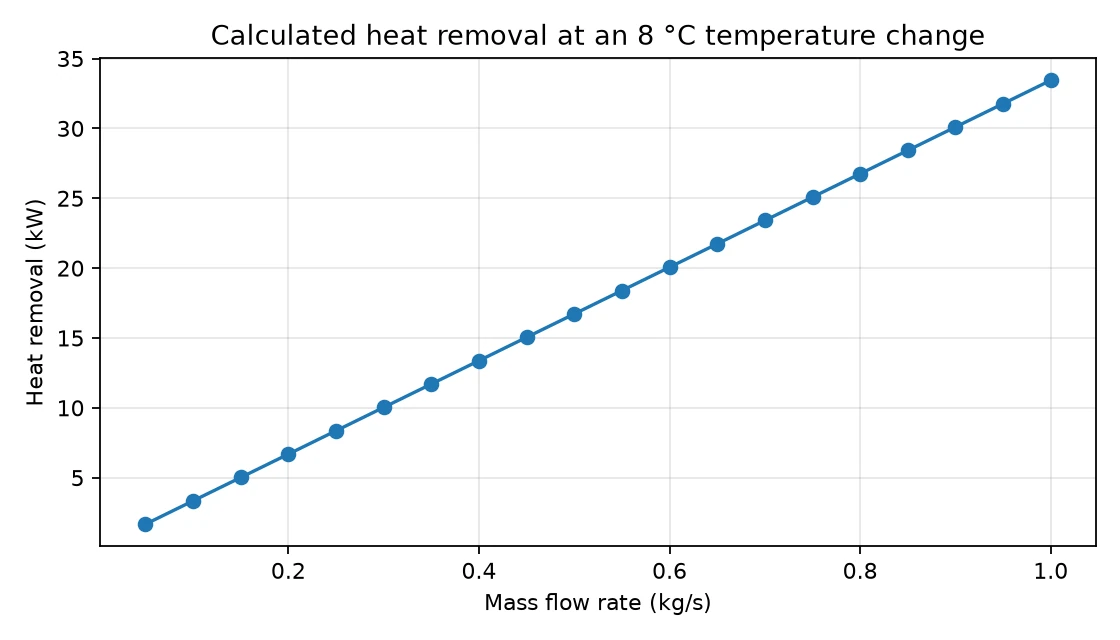
The example chart varies mass flow while holding specific heat and temperature rise fixed. It shows the equation’s response to those assumptions, rather than predict how a particular cold plate or pump would perform. Software consistency checks do not establish experimental validation.
Current status and next step
The educational package is implemented. The next learning step is to relate a calculation to a well-defined measurement boundary and explain when the underlying assumptions apply.